Oman: An Unexpected Launchpad For The New Era Of Aviation
When we set out to identify the world’s most suitable locations to deploy our Operational Launch Program (OLP) in partnership with our customers and suppliers, the search extended across continents. The criteria were demanding: a location with forward-looking regulatory leadership, diverse and challenging operational environments, supportive government partnerships, and an economy positioned to benefit directly from hybrid-electric vertical takeoff and landing (VTOL) technology.
Following a presentation by our CEO, James Dorris, at COP28 in Dubai our search quickly narrowed. Oman’s Minister of MTCIT, His Excellency Saeed bin Hamoud bin Saeed al Maawali, approached Odys via Rebecca Olson, CEO of the Oman American Business Council, to learn more about our aircraft and capabilities. In the discussions that followed, it was clear that Oman stood out decisively as a unique launchpad for customer operations.
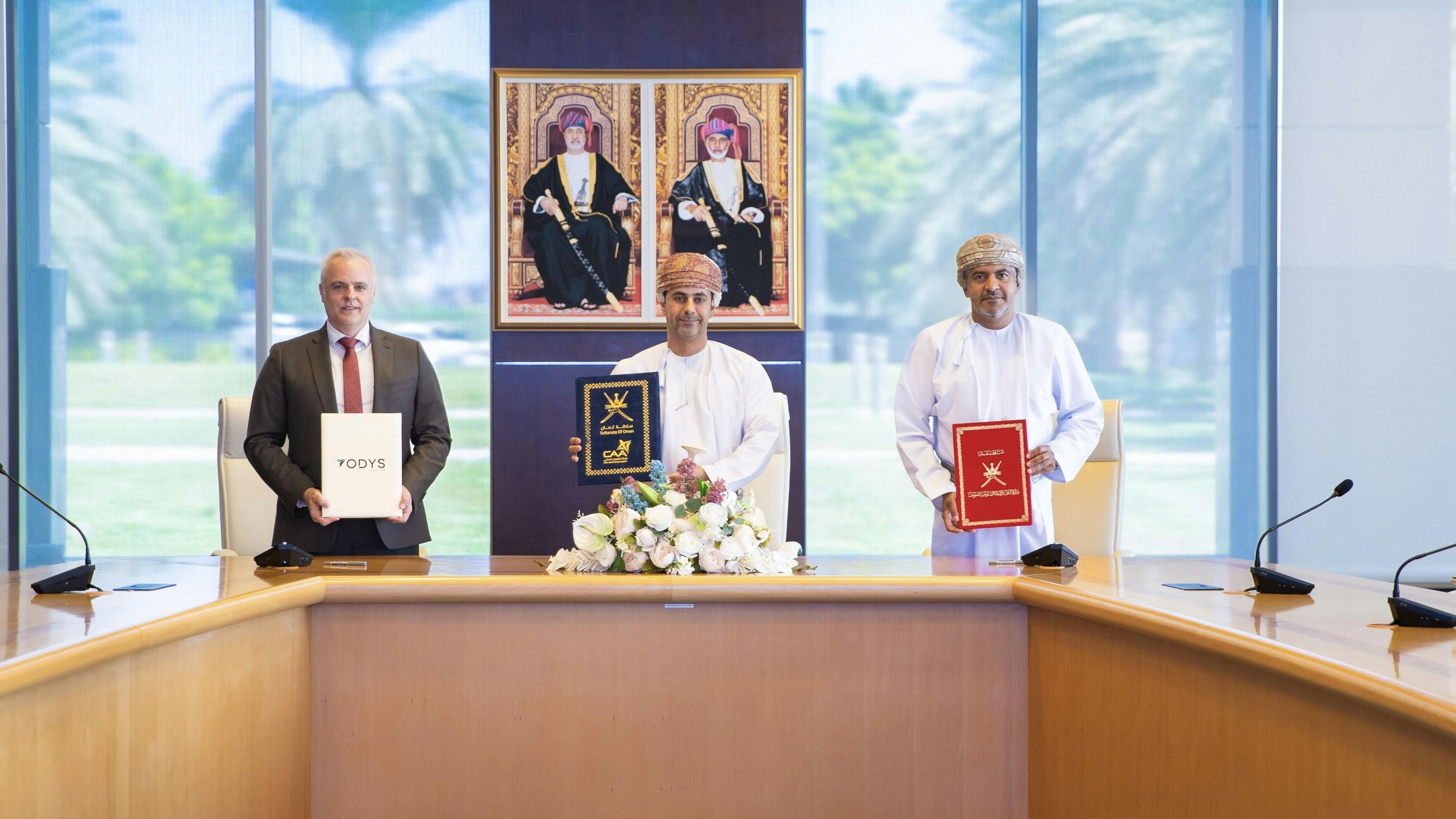
With the signing of our landmark agreement with the Oman Civil Aviation Authority (CAA), and the Ministry of Transport, Communications and Information Technology (MTCIT), the Sultanate of Oman will now host one of the world’s most comprehensive Advanced Air Mobility (AAM) end-to-end evaluations: the Odys OLP.
But beyond the headline, the deeper question is why Oman? What makes this nation of striking landscapes and visionary leadership such an appropriate proving ground for next-generation aviation technology?
The answer lies in a rare intersection of geography, culture, governance, and ambition.
A Geography Built for Aerial Innovation
Few places on Earth offer the variety of terrain and airspace complexity that Oman does within a single national boundary. From the dramatic Hajar Mountains that rise above Muscat, to the sweeping desert interiors of Dhofar, to the offshore oil and gas fields in the Arabian Sea, Oman provides a natural testbed for the full spectrum of AAM applications that fit seamlessly with our product portfolio - civil, commercial, and defense.
The nation’s vast, sparsely populated regions are ideal for testing VTOL operations over extended ranges, without the congestion or restrictive airspace found in denser urban centers. This makes it possible to run live, highly meaningful end-to-end evaluations that combine aircraft operations, supporting infrastructure, autonomy, and logistics networks, on routes that mirror high demand commercial use cases.
Our Laila aircraft combines vertical takeoff and landing capabilities with hybrid-electric propulsion and 450 miles of range, and Oman’s geography offers the perfect environment to validate not only the aircraft itself but also its system-level integration.
Oman’s climate also plays a key role. High temperatures, shifting desert winds, and maritime humidity provide ideal conditions for validating system-wide performance and reliability. These challenging environments provide the data that will be essential for scaling our aircraft globally.
But it’s not just Odys and our customers who benefit from the OLP. Since early 2024, Odys and Honeywell Aerospace have collaborated on the design of new Ground Control Stations to support the rollout of the Laila aircraft, and this functionality will be a key aspect of this customer test program.
"As companies seek to expand their development and operation of uncrewed vehicles, safe operation from a remote environment is critical. Our planned collaboration with Odys Aviation will represent a significant milestone, moving our innovative solutions from testing to real-life scenarios"
- David Shilliday, Vice President, Advanced Air Mobility, Honeywell Aerospace Technologies
Imagine a single Laila flight sequence: vertical take off near Muscat, no runway required, horizontal cruise across the desert, time-critical cargo delivered to a remote oil and gas facility, and autonomous return flight with real-time monitoring from a central operations hub. Every aspect of that ecosystem, from regulatory compliance to power management to communications integrity, can be tested here. And that’s just one mission. Oil and gas, commercial logistics, medical transport, maritime surveillance, and infrastructure monitoring sectors all have numerous mission profiles that can be validated in Oman.
A Government That Welcomes Innovation
If Oman’s geography provides the proving ground, its governance provides the enabler.
Oman’s leadership has taken deliberate steps to position the nation as a global testbed for emerging aviation technologies. The Civil Aviation Authority has adopted a progressive and adaptive regulatory stance; one that recognizes innovation and safety as complementary forces rather than opposing priorities.
This forward-thinking approach has also been noted on the global stage. His Excellency Eng. Naif Ali Hamad Al Abri, President of Oman’s Civil Aviation Authority, was recently elected as President of the 42nd Session of the ICAO Assembly, the world’s highest decision-making body in civil aviation. In this role, His Excellency will guide consensus-building and advance decisive resolutions in support of ICAO’s mission - safety, security, sustainability and digital transformation - throughout the Assembly’s duration. This distinction underscores Oman’s deep commitment to innovation, international collaboration, and the responsible advancement of next-generation flight technologies. The OLP represents the cornerstone of Oman’s AAM strategy - turning policy ambition into real-world progress.
Our program adheres to the SORA 2.5 framework developed by the Joint Authorities for Rulemaking on Unmanned Systems (JARUS), arguably the world’s most advanced risk-based regulatory system aligned with the International Civil Aviation Organization’s (ICAO) principles for unmanned aircraft operations. The robustness of this framework was most recently validated by the European Aviation Safety Authority (EASA), who formally introduced the latest version SORA 2.5 in September of this year. EASA is the leading regulatory body to adopt the framework covering 31 member states, with more than a dozen non-EU CAAs following suit.
The OLP is far more than end-to-end flight tests. Odys, alongside our partners and customers, will conduct live operations that directly support regulatory implementation. Oman is actively working with us to co-develop the policies that will define how advanced aviation is integrated safely into national airspace systems. This regulatory openness reflects a broader government philosophy that prioritizes partnership and practical innovation.
Alignment with Oman Vision 2040
Vision 2040 outlines a future where Oman transitions from an oil-dependent economy to one driven by innovation, sustainability and knowledge-based industries. Among its core pillars are logistics excellence, advanced manufacturing, digital transformation, and energy transition, each of which aligns directly with our own mission and capabilities as a pioneering AAM company.
“This alignment of incentives creates significant opportunities for Oman, which finds itself at a historic crossroad of trade, economic, tech, and geopolitical importance, given massive investments in artificial intelligence and renewable energy by sovereign wealth funds, in a region that remains integral to global markets and stability, and for US companies who wish to do business there.”
- Nic Adams,Atlantic Council
Odys’ hybrid-electric VTOL technology addresses multiple Vision 2040 priorities at once:
- Sustainability and Energy Transition: Our hybrid propulsion system reduces carbon emissions by 76% on regional routes, an ideal fit for Oman’s geography and push toward lower-carbon transport.
- Logistics and Connectivity: The OLP will demonstrate how Laila can enhance connectivity and supply routes across Oman’s rugged terrain, linking coastal, desert and mountain communities without major infrastructure expansion.
- Economic Diversification: Advanced aviation creates high-value employment in engineering, manufacturing, and digital services, all of which are central to Oman’s 2040 economic goals.
- National Resilience: The inclusion of civil defense and emergency applications strengthens Oman’s disaster response and defense readiness, supporting Vision 2040’s objective of a secure and adaptive nation.
Commercial and Civil Use Cases: Connecting Industry and Infrastructure
Oman’s economic profile offers a wide range of use cases that directly align with our aircraft’s capabilities. The Sultanate’s desert-based oil fields and offshore platforms present recurring challenges for logistics. Ground-based transport from Oman’s capital, Muscat, to their remote oil fields can take as long as 36 hours, and in the interest of safety, travel through the desert at night is prohibited. Laila can complete the same missions in under three hours, delivering essential equipment quickly and without the risk to human safety.
Remote facilities and communities present numerous other challenges. Oman’s extensive network of pipelines, ports and power facilities requires regular monitoring. Laila’s long range and payload capacity make it uniquely capable of conducting autonomous inspection missions, capturing high-resolution data while operating safely over remote regions. For isolated communities, our aircraft can deliver critical medical supplies, humanitarian aid, or cargo over long distances with lower operating costs than traditional rotorcraft.
Defense Applications: A Dual-Use Advantage

Odys was founded on a dual-use philosophy - advancing both civil and defense aircraft capabilities utilizing a single unified architecture. It’s an approach that allows for mission modularity and rapid deployment. But proving commercial capabilities doesn’t explicitly validate defense readiness.
The Oman OLP will go beyond demonstrating commercial and civil operations. Separately, it will utilize the nation’s unique environment to conduct end-to-end defense demonstrations. Oman’s Royal Air Force and Royal Navy will be collaborating with Odys to jointly evaluate autonomous and logistics missions, ISR, tactical resupply, and even vertical takeoffs and landings from maritime vessels.
The ability to operate commercial, civil, and defense missions through a single collaborative program is precisely what makes the Oman OLP so significant. It’s not just a limited-impact flight test, it’s a real-world demonstration of how next-generation mobility can serve both economic growth and national security.
A Model for Global Expansion
We view the Oman OLP as the first in a series of globally scalable launch programs, designed to accelerate the deployment of Odys’ hybrid-electric VTOL operations worldwide.
By testing not just the aircraft, but end-to-end AAM customer use cases, Oman is establishing a repeatable model that can be easily deployed in other early-adopter nations.
With the OLP’s kickoff in early 2026, Oman will become the world’s leading hub for advanced long-range air mobility; a place where aviation’s future is not only imagined or talked about, but proven.
The Future Is Taking Off From Oman
The partnership between Odys and the Sultanate of Oman represents a bold convergence of vision and capability. It shows what happens when an innovative company meets a nation ready to reimagine what’s possible in aviation.
By 2026, Oman will not only be home to the first operational deployment of hybrid-electric VTOL systems at scale, it will also be the birthplace of a new global standard for how advanced air mobility is introduced, regulated and commercialized.
Oman’s story has always been one of exploration and connection. With Odys’ Laila aircraft soon in its skies, that legacy is about to enter a new era, one defined not by the limits of geography, but by the possibilities of flight.